
Wildfire Smoke Smell in Carpet: Why It Lingers and How to Actually Remove It
Every fire season, Rogue Valley homes can end up with a faint, stale smoke smell that remains after outdoor air clears. Sometimes the odor seems to return when the heat comes on in October. Learn how carpet, padding, indoor air, and HVAC systems may be involved—and what to ask before booking a cleaner.
If you’re dealing with lingering smoke odor and looking for professional carpet cleaning in Medford, OR , understanding where the odor is coming from is the first step. Smoke-related residues can remain in porous materials such as carpet and upholstery even after the outdoor air has cleared.
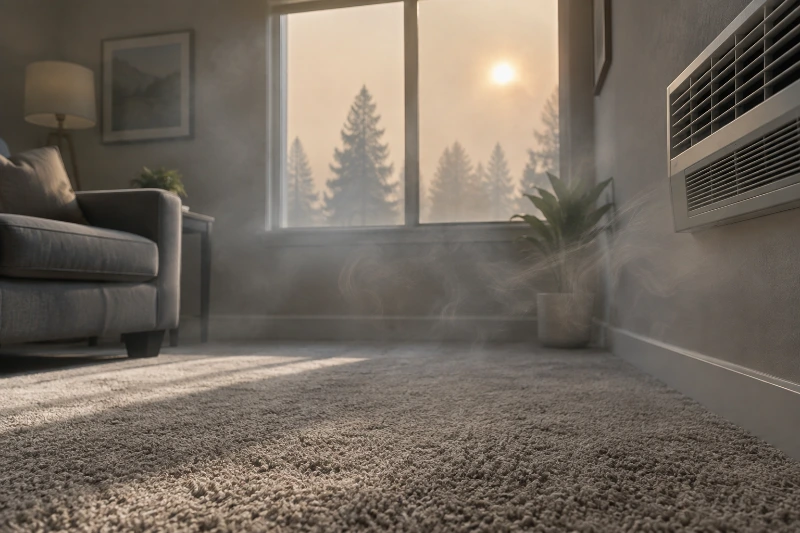
The Air Can Clear Before the Carpet Does
Air purifiers and ventilation can improve indoor air, but residues that have settled into carpet and other porous materials can remain. That is why a room may smell fine for a while and then become noticeably smoky again.
Why Smoke Odor Gets Into Carpet in the First Place
Wildfire smoke contains very fine particles that can travel indoors and settle on surfaces, including carpet fibers.
During prolonged smoke exposure, particles and smoke-related residues can enter a home on clothing, shoes, pets, and through normal air exchange. HVAC systems can also circulate airborne particles through rooms.
Over time, some of those residues can settle into carpet fibers and other porous materials. The odor may not always be obvious immediately, particularly when the indoor air has been ventilated.
After a difficult fire season, lingering odor can therefore remain even after outdoor air quality has improved.
Smoke exposure isn’t always obvious
A room does not have to look visibly dirty for smoke-related odor to remain. Carpet, upholstery, curtains, and other porous materials can hold residues that are difficult to notice until conditions change.
Why It Lingers Even After the Air Clears
Removing airborne smoke and addressing smoke that has already settled indoors are two different problems.
Air purifiers target the air
Air purifiers can help reduce airborne particles, but they do not automatically remove residues that have already settled into carpet and upholstery.
Carpet is porous
Carpet fibers and other fabric surfaces can collect smoke-related residues during prolonged exposure.
Humidity can change the smell
Changes in temperature or humidity can sometimes make lingering odors more noticeable, even after the original smoke event has passed.
What Actually Removes Smoke Odor?
The right approach depends on the amount of exposure, the condition of the carpet, and how much residue has settled into the carpet system.
Hot Water Extraction
Hot water extraction can physically remove soil and residues from carpet fibers rather than simply covering the smell with fragrance. Light-to-moderate smoke odor may respond well to extraction alone.
Odor-Neutralizing Treatment
Heavier or repeated smoke exposure may benefit from an additional odor-neutralizing treatment when extraction alone does not provide the desired result.
Checking Beyond the Surface
In homes with substantial or repeated smoke exposure, residues may extend deeper into the carpet system. If surface cleaning does not hold, the backing or pad may need further evaluation and treatment.
Timing It Around Fire Season
Once outdoor air quality has improved, addressing smoke-affected carpet sooner can be worthwhile rather than allowing residues and odors to remain for months.
If your home went through a difficult fire season and the smell remains after the outdoor air has cleared, it may be worth addressing the carpet directly rather than simply waiting for the odor to fade.
Why Smoke Smell Can Return When the Heat Comes On in October
A home may seem fine through summer, then develop a stale or smoky smell when the furnace starts running more often. That timing can be a clue, but it does not prove that the carpet is the source.
Airflow changes around the home
Heating systems circulate indoor air and can disturb dust or move air across surfaces. If odor-producing residue remains on carpet, upholstery, or other materials, the smell may become easier to notice. A filter or another HVAC component may also be contributing.
Residue may remain on soft surfaces
Carpet, rugs, curtains, and upholstery can collect particles and smoke-related residue during exposure. Ventilation can improve the air without removing material that has already settled on indoor surfaces.
The carpet pad is only one possibility
If the smell seems strongest near the floor or persists after surface cleaning, the carpet backing or pad may warrant evaluation. Do not assume the pad is contaminated without an inspection; other indoor sources can produce similar symptoms.
Check the heating system too
If the odor starts specifically when the furnace operates or seems strongest at vents, check the filter according to the manufacturer’s instructions and consider an HVAC professional. Carpet cleaning cannot resolve every heating-system or building-material issue.
Useful clue: Note when the smell starts, which rooms are affected, and whether it is stronger near vents, carpeted areas, or upholstered furniture. These observations can help a professional decide what to inspect next.
PM2.5, Wildfire Smoke, and Carpet Padding: What the Evidence Means
Wildfire smoke contains fine particulate matter known as PM2.5. The Oregon Department of Environmental Quality explains that these particles are 2.5 micrometers in diameter or smaller and can affect health. DEQ monitors air quality and issues advisories when smoke degrades the air.
Fine particles can enter buildings during smoke events and some can settle on indoor surfaces. Carpets and other soft materials may collect deposited particles and smoke-related residue. The amount that remains depends on the exposure, building conditions, ventilation, and materials present.
However, a smoky smell is not a PM2.5 measurement. You cannot determine the concentration of airborne particles by smelling a carpet, and carpet cleaning alone does not measure or certify indoor air quality. If air quality is your concern, use official monitoring and follow current public-health guidance rather than relying on odor as a measurement.
Carpet padding may contribute to a lingering odor in some cases, but it is not automatically the cause. The carpet face, backing, furniture, curtains, HVAC system, or other building materials may also be involved. If surface cleaning does not help, ask the cleaner what can reasonably be inspected and whether another qualified professional may be needed.
Air-quality resources: Check the Oregon DEQ Air Quality Index for current conditions and the DEQ Wildfire Response page for wildfire smoke and cleanup guidance. When outdoor smoke is present, follow official advice on reducing exposure and using suitable indoor filtration.
The Almeda Fire and Smoke Exposure in the Talent–Phoenix Corridor
The Rogue Valley has experienced severe wildfire impacts close to homes and businesses. The Almeda Drive Wildfire began on September 8, 2020, in Jackson County and burned through a greenway and adjacent urban area, according to the National Centers for Environmental Information’s Storm Events Database.
That local history matters because smoke exposure can differ from one property to another. Wildland smoke is largely associated with burning vegetation, while fires that spread through developed areas may also involve structures, vehicles, and household contents. The mixture depends on what burned and the conditions of the fire; it should not be assumed that every property experienced the same kind of contamination.
The fact that the Almeda Fire occurred in 2020 does not establish that a smoky odor noticed today comes from that event. More recent smoke, household sources, dust, and HVAC components may also be responsible. A home’s fire history is useful context, but the source of a current odor still needs to be assessed.
For homes with visible ash or substantial fire damage, use official cleanup guidance rather than treating the problem as routine carpet maintenance. Disturbing ash can put particles back into the air. Follow DEQ’s advice for returning to a home that survived a wildfire, and consult appropriately qualified restoration professionals when damage extends beyond carpet.
Source: NOAA/NCEI Storm Events Database — Almeda Drive Wildfire, Jackson County, September 8, 2020. For current smoke levels and official guidance, use the Oregon DEQ Wildfire Response page.
What to Ask Any Carpet Cleaner About Wildfire Smoke
Before scheduling a service in Medford or elsewhere in the Rogue Valley, ask how the cleaner plans to evaluate the odor and what the proposed treatment can realistically accomplish.
Will you inspect before recommending treatment?
Explain when the smell occurs, which rooms are affected, and whether there is a known smoke-exposure history. A cleaner should be clear if the source may be outside the carpet.
What method will you use, and why?
Ask whether the service is routine soil removal, an odor-focused treatment, or both. The appropriate method depends on carpet construction, residue, and exposure severity.
How will you evaluate the backing or pad?
Ask what can be determined without lifting the carpet and when further inspection may be necessary. No one should promise the pad is the source without supporting findings.
What if the odor returns?
Ask what follow-up is included, whether additional treatment costs extra, and what conditions or exclusions apply. Get the answer in writing and avoid guarantees that are not clearly defined.
Keep expectations realistic: Professional carpet cleaning may help when carpet is contributing to the odor, but it cannot guarantee that every smoke smell in an entire building will disappear. HVAC systems, wall cavities, insulation, and other materials may require separate evaluation.
Still smelling smoke after the air outside has cleared?
Common Questions About Smoke Odor in Carpet
How long after a wildfire smoke event should I get carpet cleaned?
Once outdoor air quality has returned to normal, addressing smoke-affected carpet within the following weeks can be worthwhile. Earlier cleaning may help remove residues before they remain in the carpet system for an extended period.
Can a regular cleaning remove smoke smell, or does it need something special?
Standard hot water extraction may handle light-to-moderate smoke odor well. Heavier or repeated exposure may benefit from an additional odor-neutralizing treatment depending on the condition of the carpet.
Why does the smoke smell seem worse on humid days?
Changes in temperature and humidity can sometimes make lingering odor more noticeable. That can make a smell that seemed gone become easier to detect during damp weather.
Does air duct cleaning help with carpet smoke odor?
Duct cleaning addresses potential smoke-related residue within the HVAC system, while carpet cleaning addresses residues that have settled into carpet. After significant smoke exposure, these can be separate areas that may need separate attention.
Why does smoke odor return when the heat comes on?
Heating changes airflow and can make an existing odor easier to notice. The source could be carpet, upholstery, dust, an HVAC filter or another building material. If the smell is strongest when the furnace starts, consider an HVAC inspection as well as checking affected soft surfaces.
Can PM2.5 levels be determined by smelling my carpet?
No. Odor is not a measurement of PM2.5 concentration or indoor air quality. Check official air-quality information from Oregon DEQ and follow current public-health guidance during smoke events.
Could the carpet pad be holding the smoke smell?
It is possible, depending on the exposure, but the pad is only one potential source. Carpet backing, furniture, curtains, HVAC components and other building materials may also contribute. Inspection is needed before deciding what treatment is appropriate.
Where can I check official wildfire smoke information for Oregon?
Use the Oregon DEQ Air Quality Index for current conditions and the DEQ Wildfire Response page for smoke, air-quality and cleanup resources.
Learn More About Smoke Odor Cleaning
If you want to understand the cleaning method or see how we approach wildfire smoke odor specifically, these pages go into more detail.
Still Smelling Smoke After This Fire Season?
Get a clear explanation of what may be causing the lingering odor and what cleaning approach makes sense. Serving Medford, OR and the Rogue Valley.